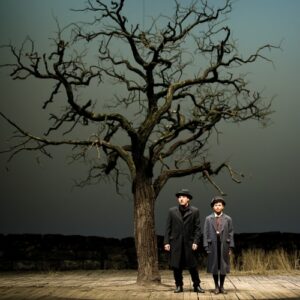
Six Characters in Search of an Author
A thrillingly strange play that tears theatre apart in front of the audience and asks whether stories can ever capture the truth of a human life.
Why it matters right now
Every year brings another argument about truth, identity and performance. Social media encourages people to turn themselves into characters. Public life rewards spectacle over sincerity. Artificial intelligence can imitate human voices, faces and emotions with increasing precision. Six Characters in Search of an Author feels uncannily modern because it understands how unstable reality becomes once performance enters the room. Pirandello asks a question that has only grown more urgent since 1921: who owns a story once it has been told? The play turns a rehearsal into a philosophical battleground where actors, characters and audience members struggle to agree on what is real. A century later, theatre still feels like it is catching up with it.
The story in three sentences
During a rehearsal in an empty theatre, a group of six unfinished characters suddenly appear and demand that their story be staged. They claim that their author abandoned them before completing the drama of their fractured family, leaving them trapped forever inside their own unresolved suffering. As the actors attempt to recreate the events, the line between performance and reality begins to collapse.
The moment you will remember
The final chaos arrives with terrifying speed. A child disappears behind the set. A gunshot rings out. Actors scream, stage managers panic and the surviving characters insist that what the audience has witnessed was real. The company argues over whether anyone has actually died while the theatre itself descends into confusion. Pirandello leaves the audience stranded inside uncertainty, watching people desperately search for a version of reality everyone can agree upon.
Who it is for
Read or see this if: you love theatre that plays games with form and reality. If you are interested in the roots of modern experimental drama. If you enjoy works that leave audiences arguing long after the curtain call. The play shaped generations of writers and directors who wanted theatre to question itself rather than simply tell stories.
Be aware if: you prefer clear narratives with stable rules and tidy conclusions. Pirandello deliberately keeps shifting the ground beneath the audience’s feet, and the play gains its power from that instability.
The debate
The play’s central argument still divides artists and audiences alike. Are the six characters more “real” than the actors because their emotions remain fixed forever inside a story? Or does their inability to change make them less human than the performers trying to interpret them? Pirandello presents theatre as an art form built from compromise, imitation and misunderstanding. Every attempt to stage the family’s tragedy distorts it slightly. The unsettling possibility raised by the play is that human beings may experience their own lives in exactly the same way, forever trapped between what they feel and what other people can actually understand.