
- 20th Century
- 19
What happens when one friend spends an exorbitant amount of money on an all-white painting? In Yasmina Reza’s razor-sharp comedy “‘Art’,” this seemingly simple act detonates a friendship bomb that had been quietly ticking for years. Through a deceptively simple premise, Reza crafts a masterful exploration of taste, friendship, and the uncomfortable truths we hide from those closest to us.
Christopher Hampton’s translation
Faber and Faber edition.
Includes Art, Life x 3, Conversations After a Burial,and The Unexpected Man. Translated by Christopher Hampton
Acting Edition by Dramatists Play Service
The Nicholas Rudall version is often preferred for performance.
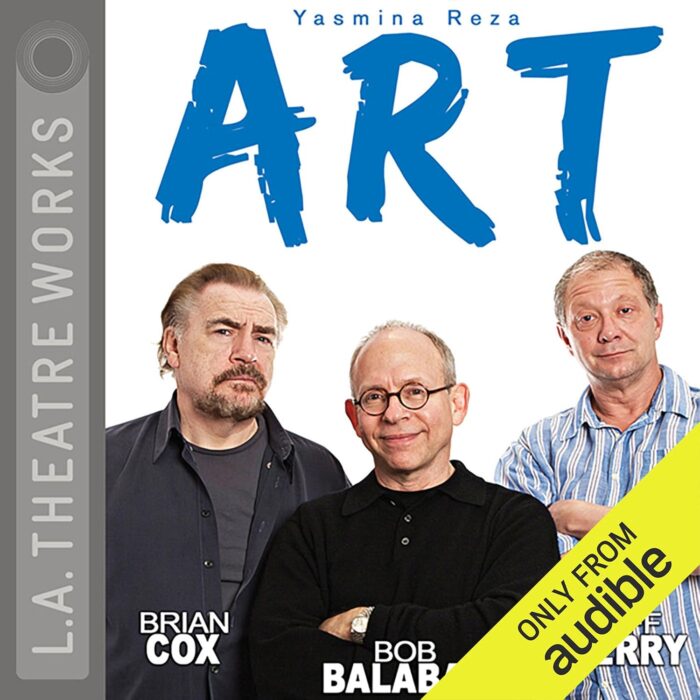
A gripping professional production by LA Theatre works. Starring Brian Cox, Bob Balaban, and Brian Perry.
Written in the mid-1990s, “‘Art'” emerged during a period when contemporary art prices were skyrocketing and conceptual art was becoming increasingly minimalist. The play brilliantly captures the zeitgeist of an era when a plain white canvas could command astronomical prices and spark heated debates about the nature of art itself. Reza’s work also coincided with a growing trend of questioning traditional friendship dynamics in an increasingly materialistic society.
Serge, a dermatologist with aspirations of being a serious art collector, purchases a white painting for 200,000 francs (approximately $40,000). His friend Marc is horrified by both the purchase and the price, viewing it as a betrayal of their shared values. Yvan, caught in the middle of this disagreement, attempts to please both sides while dealing with his own personal crisis involving wedding invitations. As the evening unfolds, what begins as a disagreement about taste evolves into a brutal examination of their 15-year friendship, revealing deep-seated resentments and insecurities.
The white painting serves as the perfect MacGuffin – it’s less about the artwork itself and more about what it represents to each character. For Serge, it’s sophistication and cultural advancement. For Marc, it’s pretension and betrayal. For Yvan, it’s yet another battlefield where he must play peacemaker.
The play’s true subject is the fragile nature of male friendship. Each character desperately seeks validation from the others, while simultaneously resenting this need. Marc’s violent reaction to the painting stems not from aesthetic disagreement but from the fear that Serge has outgrown their friendship.
Reza masterfully explores how friendships often operate on delicate power balances. Marc has always been the “mentor” figure, and Serge’s independent art purchase threatens this dynamic. Yvan’s attempts to maintain neutrality only highlight how friendship groups often require these unspoken hierarchies to function.
Reza’s genius lies in her ability to craft a play that works on multiple levels. On the surface, it’s a witty comedy about art appreciation. Deeper down, it’s a penetrating study of male friendship, cultural pretension, and the ways we use taste to define ourselves. The play’s structure is remarkable for its economy – everything takes place in real-time, with no scene changes or theatrical flourishes.
“‘Art'” has become one of the most performed plays worldwide, translated into over 30 languages. Its success demonstrated that intellectual comedy could still draw mainstream audiences. The play’s influence can be seen in numerous subsequent works examining friendship through the lens of cultural taste, from novels to television shows.
The play’s minimalist requirements (three actors, one set, and a white painting) make it a favorite for theater companies. However, this simplicity is deceptive – the roles require actors capable of navigating complex emotional terrain while maintaining perfect comic timing. The white painting itself becomes almost a fourth character, its presence looming over every interaction.
Christopher Hampton’s English translation is considered definitive, capturing both the wit and underlying tension of Reza’s original French text.
In our era of social media debates and cultural polarization, “‘Art'” feels more relevant than ever. The play’s exploration of how taste defines identity and friendship resonates strongly in a time when people often judge each other based on their cultural preferences. The question of what makes art valuable remains hotly debated, particularly in the age of NFTs and digital art.
“‘Art'” succeeds brilliantly because it uses a simple premise to explore universal truths about friendship, status, and self-image. Its combination of wit, insight, and emotional depth makes it a must-read for anyone interested in contemporary theater. More than just a play about art, it’s a masterful study of how we navigate relationships in a world where taste has become a marker of identity.
Whether you’re a theater enthusiast or simply interested in human nature, “‘Art'” offers a compelling read that will likely leave you examining your own friendships and the unspoken rules that govern them.
Watch a production of Art by Chenango River Theatre from 2022.
Internet is huge! Help us find great content
Great plays from around the world
Leave a Reply