
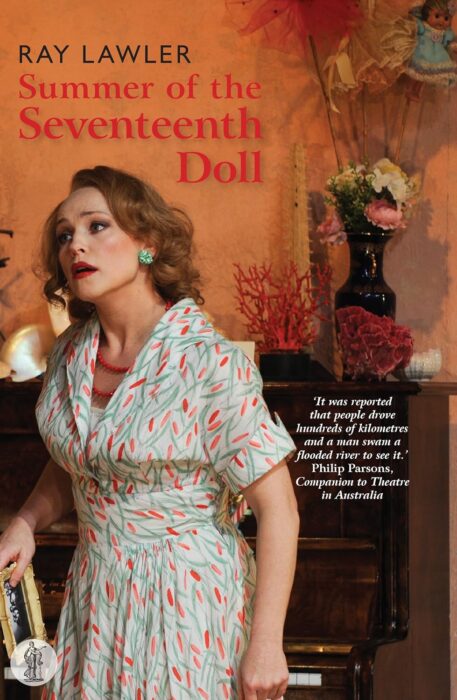
Summer of the Seventeenth Doll
Published by Currency Press, this is Ray Lawler’s revised 2012 script of his celebrated play, in which two cane cutters and their women come to terms with middle-age.
Tip: you can read the play online for free on the Internet Archive. You just need to make an account, then click “borrow” and off you go!
First performed in 1955 by the Union Theatre Repertory Company in Melbourne, Summer of the Seventeenth Doll is widely treated as a decisive moment in Australian theatre because it brought working class Australian speech, social reality, and local settings to the centre of the stage with a confidence that challenged older expectations of what serious theatre should sound like and whom it should represent. Its success strengthened the sense that Australian drama could stand on its own terms, rather than borrowing its authority from imported models or accents.
The play is set in inner Melbourne and unfolds during the annual summer visit of two Queensland cane cutters, Roo and Barney. After the cane season ends, they travel south to spend their layoff with Olive and Nancy in a ritual shaped by drinking, performance, and shared stories about youth and freedom. Each year Roo brings Olive a kewpie doll, and the accumulation of dolls becomes a record of the ritual itself, a private calendar that measures how long the fantasy has been sustained.
What drives the drama is the moment when the ritual stops working. The seventeenth summer exposes the cost of living through an idealised version of masculinity and pleasure that depends on physical prowess, steady earnings, and the ability to keep disappointment offstage. Scholars have often read the play as an inquiry into masculinity, desire, and national self image in the 1950s, including the pressure to embody the mythic Australian “outback hero” while living in the ordinary constraints of work and ageing (Cousins 1987, Pratt 1996). At the same time, the women are not passive witnesses. The play tracks how gender expectations, respectability, and emotional labour shape what the men can admit about themselves and what the group can tolerate as truth.
The strain between a public identity that must be performed and a private reality that keeps changing is a major part of what makes the play stand the test of time. Roo and Barney’s seasonal work and short period of release still speaks to today’s cycles of precarious labour, burnout, and the urge to concentrate joy into brief windows that are then treated as proof that life is under control.
The play also offers a clear lens on how nostalgia operates. It can bind people together, but it can also demand that they deny change, deny vulnerability, and punish anyone who disrupts the script. In that sense, Lawler’s play still reads as a rigorous study of social myth and the human cost of keeping a story alive after it no longer fits.
Ray Lawler was an Australian playwright, actor, and theatre director whose work helped reshape modern Australian drama. He was born in Melbourne, Victoria in 1921, and Summer of the Seventeenth Doll became his best-known play. His career in the theatre spanned decades, and he died in 2024 at age 103.
References
Cousins, Kerry. “Gender and Genre: The Summer of the Seventeenth Doll.” Fremantle Arts Centre Press Reading Room, freotopia.org.
Pratt, Catherine. “Playing with Dolls: Masculinity and Desire in Summer of the Seventeenth Doll.” LinQ, vol. 23, no. 1, May 1996, James Cook University.
“Ray Lawler.” Encyclopaedia Britannica, britannica.com.
Relevant Media
Watch the Melbourne Theatre Company’s 1977 production of the play.
Watch the 1959 film adaptation of the play starring Ernest Borgnine, Anne Baxter, John Mills and Angela Lansbury.