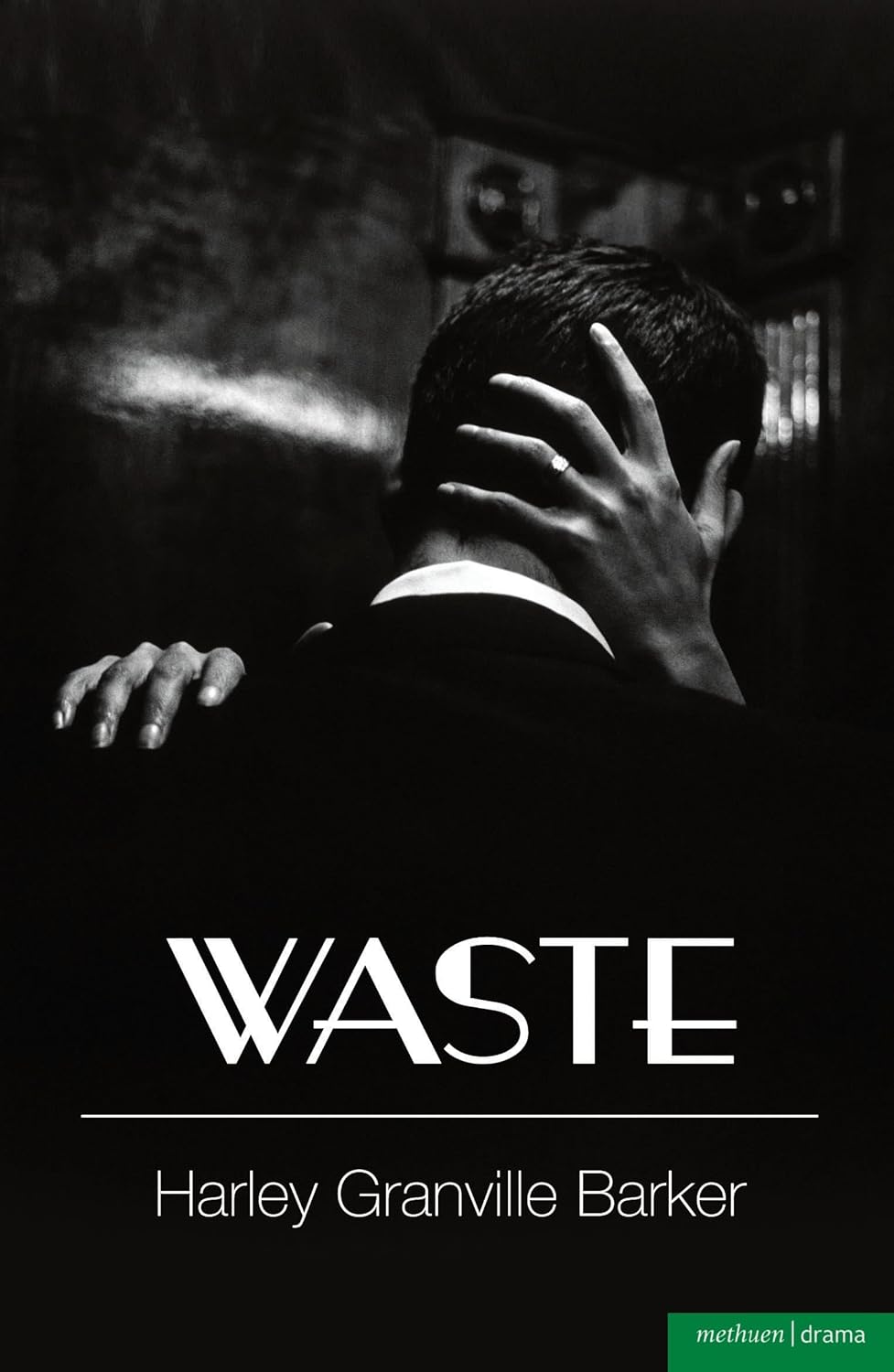
Waste by Harley Granville-Barker. This Methuen Drama edition was published to coincide with a revival of the play at the Almeida Theatre, in 2008.
Tip: You can read Waste for free on Project Gutenberg right now. Click the link and you’re good to go!
Harley Granville-Barker wrote Waste as a sharp, fast-moving political drama about power, reputation, and the hidden costs of ambition. Set in the world of British party politics, it follows Henry Trebell, an up and coming politician pushing a high stakes reform bill while his private life and his party’s internal manoeuvring threaten to unravel everything. The play keeps asking the same uncomfortable question: what gets sacrificed, and who pays, when politics becomes a machine for winning at all costs.
In treating scandal as a political instrument, Granville-Barker shows how moral language, press pressure, and party discipline can be used to contain a crisis or to destroy a rival, depending on what best serves the moment.
A crucial historical detail is that the play exists in two different versions. The first version was written in 1906 but was only given a private performance due to censorship pressures.
Waste was famously refused a licence by the Lord Chamberlain’s Office, in large part because it touches on a sexual relationship that results in an abortion and the political fallout surrounding it. The ban meant the play could not be staged publicly in Britain at the time, which is a reminder that the “boundaries” of public debate were once enforced by law and by theatre licensing.
Granville-Barker later revised the play in 1927 and it was finally given a public airing in 1936 at the Westminster Theatre in London. Modern editions and productions sometimes choose between these versions or combine elements, because the revisions affect emphasis, pacing, and how certain revelations land.
Even with its Edwardian and interwar contexts, the play reads as recognisably modern because the mechanisms it describes are modern. This includes vetting, briefing, reputation management, and the constant tension between private conduct and public responsibility.
The play’s bleakness comes from its argument that institutions can “waste” people when the maintenance of power becomes the primary goal. Characters rarely make one catastrophic decision in isolation. Instead, the play builds a chain of compromises, each one justified as necessary, until the outcome feels both shocking and inevitable.
Each version of the play frames that chain slightly differently, changing what the audience is nudged to blame, and what it is nudged to forgive.
References
Granville-Barker, Harley. Waste, 1906 (Project Gutenberg).
McCoy, Briana. “Waste: A Play That Still Raises Hackles.” TheatreMania, 2000.
Teixeira, Ana Rita, and Eduarda Santos. “The Censorship and Scandal in Harley Granville Barker’s Waste.”