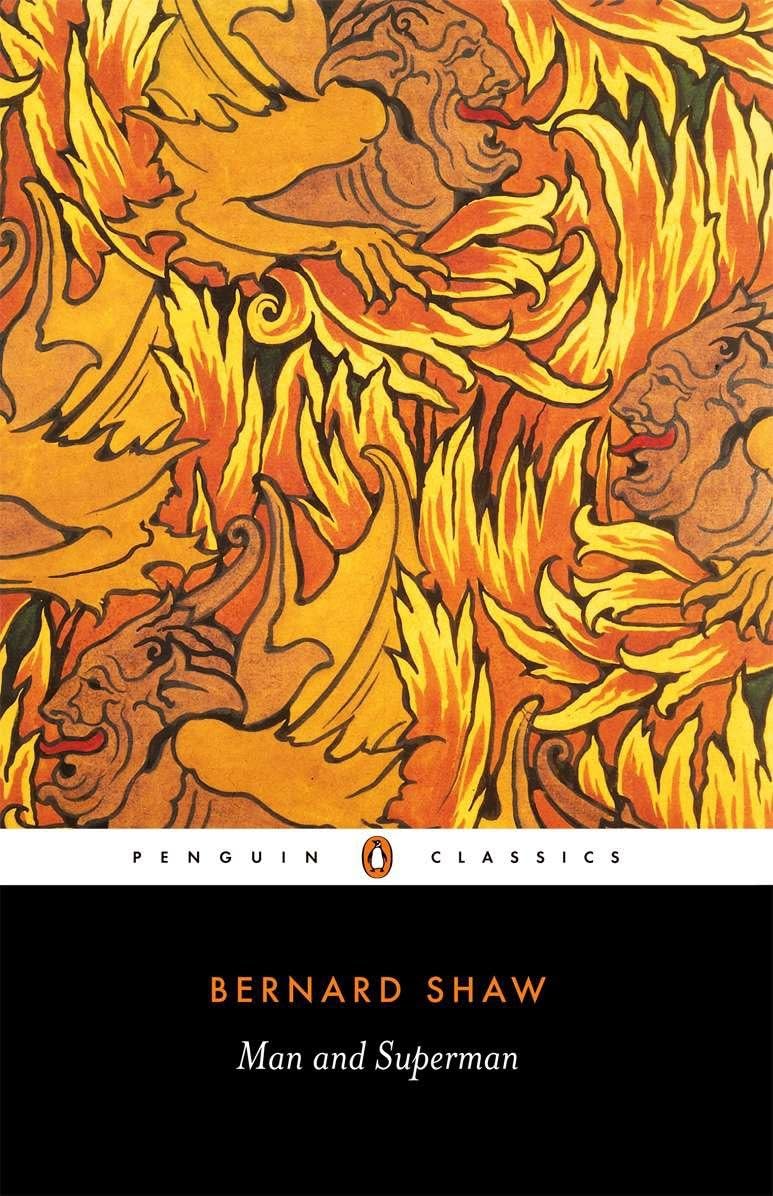
Man and Superman published by Penguin Classics. This is the definitive text produced under the editorial supervision of Dan H. Laurence. The volume also includes Shaw’s preface of 1903 and his appendix, “The Revolutionist’s Handbook”; the cast list from the first production of Man and Superman; and a list of his principal works.
Tip: You can read Man and Superman for free on Project Gutenberg. Choose your format and you’re good to go!
Written in 1903, Man and Superman is one of the clearest statements of George Bernard Shaw’s mature theatrical ambition of creating drama that can entertain as comedy while also functioning as sustained argument. Shaw, born in Dublin in 1856 and later active in London, built an international reputation as a playwright, critic, and public intellectual whose work is closely associated with socialism and with a theatre of ideas.
Shaw’s career sits at the intersection of art and critique. He wrote plays that challenge conventional morality, especially around class, marriage, and social power, and he did so with a distinctive mixture of wit and analytic pressure. His standing as a major modern dramatist was recognised formally when he received the Nobel Prize in Literature for 1925, awarded in 1926.
Man and Superman is significant partly because it stretches the shape of what a mainstream play could be. Shaw described it as “a comedy and a philosophy,” a phrase that signals a refusal to separate entertainment from thinking. Its theatrical audacity is most visible in Act III, the famous dream sequence usually called Don Juan in Hell. This act is set apart from the surrounding realist action and stages a long, nonrealistic debate among four figures. It has often been performed on its own, which is itself a mark of its unusual status as spoken theatre that openly foregrounds intellectual conflict.
On the surface, the plot resembles a comedy of courtship. John Tanner, a radical writer and declared opponent of marriage, becomes entangled with Ann Whitefield, whose persistence steadily corners him into the very commitment he claims to reject. Yet the romance functions mainly as a mechanism for testing ideas.
One of the play’s major themes is Shaw’s challenge to conventional accounts of romantic choice. Courtship in this play is a struggle over agency and social expectation, staged as a contest between self image and biological and cultural pressure. Another key theme is the exposure of moral performance. Characters who present themselves as progressive, respectable, or principled repeatedly reveal how easily ideals can become posture when comfort or reputation is at stake.
A third theme is philosophical evolution. Shaw connects the battle of the sexes to a larger speculative question about human development and purpose. This is where the play’s title matters: the “superman” is not a costumed hero; it is Shaw’s prompt to ask what kind of humanity might emerge if social arrangements, moral habits, and intellectual life were reorganised. Shaw’s interest in “Creative Evolution” and species development is often discussed as a central framework for the play, especially in relation to how intellect and bodily life come into conflict over time.
Act III concentrates these issues into a staged debate about Hell, Heaven, desire, and the value of thought. Its theology is provocative because it forces the audience to examine whether comfort, romance, and habit are genuinely fulfilling, or whether they function as distractions from harder forms of growth.
Man and Superman remains timely for three reasons.
First, it is a sharp text for thinking about gender and power without reducing them to slogans. The play asks how agency operates inside social scripts, how choice is shaped by pressure, and how people justify arrangements that serve them. Those questions remain central to contemporary debates about relationships and social roles.
Second, the play models argument as drama. In an era saturated with opinion, Shaw offers a formal lesson: ideas become meaningful when they have consequences, when rhetoric meets resistance, and when conversation is staged as a contest that changes what people are willing to do. Reading the play can sharpen how we recognise persuasion, evasion, and moral performance in public language.
Third, the play is historically revealing. It captures a moment when modern theatre was expanding beyond melodrama and polite comedy toward forms that could absorb philosophy, politics, and skepticism about inherited morality. For students and general readers, it provides a concrete bridge between Victorian social codes and the emerging modernist appetite for critique.
References
Shaw, Bernard. Man and Superman: A Comedy and a Philosophy. 1903. Project Gutenberg, 2002.
“The Nobel Prize in Literature 1925.” The Nobel Prize, Nobel Prize Outreach.
“Structure and Philosophy in and Major Barbara.” The Cambridge Companion to George Bernard Shaw, Cambridge University Press.